Over the past year, I’ve found myself under tremendous pressure.
Like many leaders, I’ve had to navigate business uncertainty, changes within my team, onboarding new people, and stepping back into operational responsibilities while still trying to lead with clarity and confidence.
At one point, I realized something important: How I communicate my stress matters just as much as the stress itself.
As leaders, we want to be honest with our teams, we want transparency, but I’ve learned that reacting emotionally, speaking from anxiety, or constantly projecting pressure can unintentionally create instability for others.
That realization reinforced something I’ve believed for a long time, emotional intelligence is not a soft skill. It is an essential skill.
The Problem with the term “Soft Skills”
For decades, organizations have referred to communication, leadership, emotional intelligence, relationship-building, and resilience as “soft skills. There is nothing soft about leading through uncertainty, managing conflict, motivating discouraged teams, communicating clearly under pressure, adapting when things go wrong, earning trust, responding instead of reacting
In many ways, these are the hardest skills to develop because they require self-awareness, discipline, humility, and emotional control. Ironically, in an age dominated by AI and technology, these human skills are becoming even more important.
AI Is an Essential Skill AND So Is Thinking
AI is no longer optional in the modern workplace. The organizations and professionals who embrace it thoughtfully will absolutely create competitive advantages. I believe we are also entering a dangerous phase where we are using AI as a crutch instead of a tool.
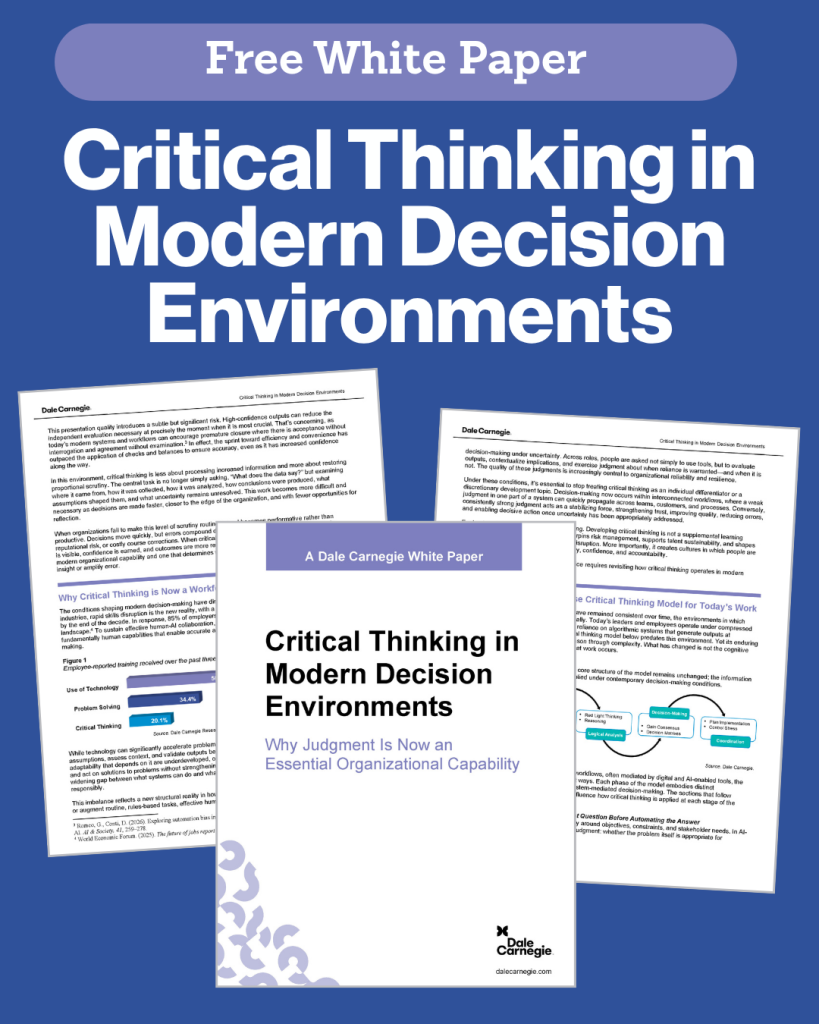
I’m noticing how professionals accept information instead of interrogating it Respond instead of thinking, generate instead of discerning. Dale Carnegie Training shared some insights on Critical Thinking in Modern Decision Making that talks to the importance of critical thinking accompany AI adoption.
The ability to challenge assumptions, interpret nuance, ask better questions, communicate context, think strategically, make sound decisions will become increasingly valuable in the years ahead. Technology can accelerate productivity, but it cannot replace judgment.

AI Fatigue Is Real
What surprises me is how quickly AI excitement is turning into AI fatigue.
Many employees are overwhelmed by the pace of change. Especially experienced and tenured professionals who now feel pressure to adapt while still delivering results at a high level. Organizations often focus heavily on teaching the technology itself, but not enough on helping people emotionally navigate change. That confidence gap matters.
People need support, encouragement, and practical guidance, not just new tools. Readiness for change is becoming an essential leadership responsibility.
The Higher We Climb, The More Behavioral The Challenge Becomes
Early in our careers, technical skills matter tremendously. The reality is thar the higher we climb in organizations, the more our challenges become behavioral rather than technical.
Leadership challenges often involve communication, trust, influence, conflict management, emotional resilience, accountability, adaptability, decision-making under pressure. These abilities are important to master and are essential to our success as people leaders. Our technical ability may open doors, but interpersonal effectiveness determines long-term success.
One of the most powerful principles I learned through Dale Carnegie is that approximately 85% of our effectiveness is driven by attitude and people skills, while only 15% comes from technical knowledge.
When you observe where organizations struggle most, that statistic becomes very believable.
Resilience Is Not Positivity
I think resilience is often misunderstood. Resilience is not pretending everything is fine. It is not toxic positivity. It is not ignoring pressure or suppressing emotion. Resilience is clarity under pressure.
It is the ability to adapt in the moment, regain perspective, and continue moving forward with determination even when circumstances are difficult. This year has personally reinforced that lesson for me.
With business pressures, team transitions, onboarding new people, and stepping back into areas where I needed to provide deeper support, I’ve had moments of feeling overwhelmed.
What has helped me most is leaning on my support structure. Sometimes resilience begins with simply talking honestly with someone you trust.
For me, sharing stressors with my wife often helps me regain perspective and avoid carrying pressure in isolation. Those conversations allow me to show up more intentionally for my team, my clients, and my family.
I’ve also learned the importance of narrowing focus. When everything feels urgent, I try to identify the top three to five priorities that matter most and tackle them one step at a time.
As the saying goes, you eat the elephant one steak at a time.
Relationships Still Win
In a world increasingly shaped by AI, automation, and digital efficiency, I believe relationships become even more valuable.
Our resume may create opportunity. Our network may open the door. But it is our interpersonal skills, reliability, communication, and follow-through that ultimately build trust and create long-term favor with others.
People remember how we made them feel, whether we listened, whether we followed through, whether we stayed composed under pressure, whether we cared.
Business is still deeply personal and perhaps that is the greatest reminder of all:
human skills matter more in a digital world.
Final Thought
We need to stop minimizing communication, emotional intelligence, resilience, critical thinking, and relationship-building by calling them “soft skills.” They are essential skills. Because while technology will continue to transform the workplace, success will still belong to people who can think critically, communicate clearly, adapt under pressure, build trust, influence positively and lead people well
And those abilities will never go out of style.
Download the white paper
https://www.dalecarnegie.com/en/resources/critical-thinking-in-modern-decision-environments